

Agencies rarely settle on a single DSP the way a smaller advertiser might. Between walled gardens, independent platforms, and the sheer range of inventory types clients now expect access to — CTV, audio, DOOH, retail media — most agencies end up running a portfolio of demand-side platforms rather than picking one "winner" and standardizing on it across every account.
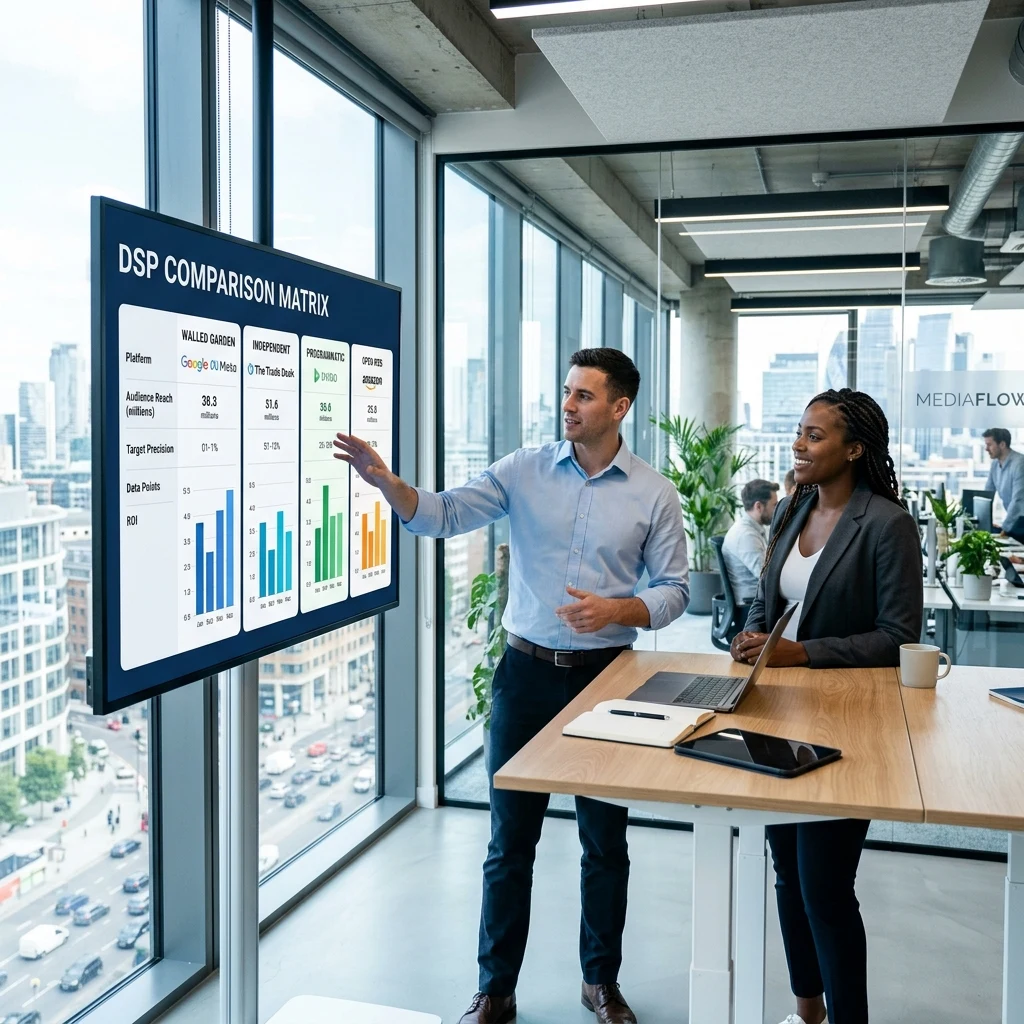
Short answer: the right DSP mix for an agency depends on the split between walled-garden platforms (like Google's DV360 and Meta's advertising tools, which offer unmatched access to their own owned-and-operated inventory but limited transparency outside it) and independent, open-internet DSPs (which offer broader cross-publisher reach, more granular reporting and API access, and more negotiable fee structures). Most agencies need both — the real evaluation work is deciding how many independent DSPs to run, and on what criteria.
1How to Evaluate a DSP for Agency Use
Before comparing specific platforms, it helps to agree internally on what actually matters for your agency's client mix. The criteria below apply whether you're evaluating a walled-garden platform, an independent DSP, or deciding whether to add a specialized platform for a specific channel like CTV or DOOH.
Fee transparency matters more than most agencies initially weigh it — some platforms bundle technology fees, data costs, and media costs into a single number that's hard to unpack, while others break out each layer clearly enough that you can explain the full cost stack to a client who asks. Inventory access matters just as much: does the platform give you real, direct access to the channels your clients are actually asking for — CTV, audio, DOOH — or does it require you to also run separate specialized platforms for those formats? Reporting and API access determine how much of your own dashboarding and optimization workflow you can build on top of the platform rather than being limited to its native UI, which is directly relevant to how efficiently your reporting and analytics function can operate across multiple client accounts. And minimum spend commitments — whether platform-level or a data/technology fee floor — determine whether a DSP is even viable for your smaller accounts or only makes sense for your largest clients.
2Walled-Garden DSPs
Google's Display & Video 360 (DV360) and Meta's advertising platform are the two most common walled-garden DSPs agencies work with. The defining tradeoff is consistent across both: you get deep, often exclusive access to their own owned-and-operated inventory and audience signals — YouTube and Google's ad exchange in DV360's case, Facebook and Instagram surfaces in Meta's case — but comparatively limited visibility into inventory outside that ecosystem, and less flexibility in how you structure fees or pull raw data out for your own analysis.
For most agencies, walled-garden DSPs aren't optional — clients expect a presence on these platforms because that's where a large share of audience attention and ad inventory sits. The evaluation question isn't usually "should we use DV360 or Meta," it's how much of a given client's budget should go through walled gardens versus independent DSPs, and how you'll reconcile reporting across both when a client wants a unified view of performance.
3Independent / Open-Internet DSPs
Independent DSPs specialize in buying across the open internet — inventory available through many different publishers and supply-side platforms rather than one company's owned properties. Their core appeal for agencies is breadth (a single platform that can reach many publishers, exchanges, and increasingly CTV and audio inventory) combined with more willingness to expose granular reporting, custom API integrations, and negotiated fee structures than a walled garden typically offers.
The tradeoff is that independent DSPs vary widely in how deep their access actually goes for any given inventory type — a platform that's strong in CTV might be weaker in DOOH, or vice versa — and in how much hands-on management versus self-serve control they expect from your team. Agencies evaluating independent DSPs should ask pointed questions about actual inventory partnerships (not just marketing claims of "access to CTV"), request a real breakdown of fee layers, and confirm what level of API access comes standard versus what requires a higher spend tier.
4Self-Serve vs. Managed-Service DSPs
Separate from the walled-garden/independent split is the question of how much of the day-to-day trafficking and optimization the DSP's own team handles versus how much falls on your agency. Self-serve platforms give your team full control over campaign setup, targeting, and optimization — which usually means lower platform fees but a higher internal labor cost, since your team is doing the hands-on work. Managed-service DSPs bundle in account management and optimization support from the platform's own team, which can be valuable for a lean agency team or for channels your team doesn't have deep in-house expertise in, but usually comes at a higher fee and less direct control.
Agencies often mix both models deliberately — running self-serve for channels where they have strong internal expertise (to keep fees low and control high) and managed-service for newer or more specialized channels like CTV or DOOH, where the platform's own expertise offsets the fee premium. This is the same logic that leads many agencies to bring in outside technical advisory support for platforms their internal team is still building expertise in, rather than defaulting to full managed service indefinitely.
5Inventory-Specific Considerations: CTV, DOOH, and Audio
As client budgets shift toward CTV, DOOH, and audio, a growing part of DSP evaluation is simply asking whether a given platform's access to these formats is direct and substantial or secondhand and thin. A DSP that added CTV support recently as a bolt-on may not have the same depth of direct publisher relationships as one built around video and CTV from the start. The same logic applies to DOOH — some DSPs have genuine programmatic DOOH capability while others route DOOH buys through a third-party integration with limited transparency.
Before committing meaningful budget to a new channel through an existing DSP relationship, it's worth asking the platform directly how that inventory is sourced, what percentage of available supply in that channel they can actually reach, and what the reporting looks like specifically for that format — the answers often differ significantly from how the channel performs in the platform's core inventory. This is also where our retail CTV case study is a useful reference for how channel-specific DSP evaluation played out in a real campaign.
6How to Choose: Building a DSP Portfolio, Not Picking a Winner
Most agencies of any real size end up running more than one DSP simultaneously, and that's usually the right call rather than a sign of an unsettled strategy. A practical starting framework: maintain access to the major walled gardens because client expectations require it, choose one or two independent DSPs based on genuine strength in the inventory types your client roster needs most, and layer in managed-service or specialized platforms only where your internal team's expertise doesn't yet cover a channel well.
Revisit this mix periodically rather than treating it as fixed — inventory access, fee structures, and platform capabilities in programmatic change quickly enough that a DSP portfolio that made sense two years ago may not be optimal today. This is closely related to the broader programmatic media buying strategy work agencies need to keep current, and it's worth reviewing alongside IAB guidance on programmatic standards when evaluating newer platforms' compliance and transparency practices.
7Managing a Multi-DSP Stack Without Losing Efficiency
The operational cost of running multiple DSPs — reconciling reporting formats, managing separate trafficking workflows, keeping optimization consistent across platforms with different UIs and capabilities — is real and often underestimated when agencies are only comparing platforms on price and reach. That operational layer is exactly what campaign management and trafficking support is built to handle, so your media planning team can focus on strategy rather than platform mechanics. If you're not sure which DSP mix fits your client roster, talk to our team — we work across multiple DSPs and can tell you honestly which combination fits your accounts and goals.