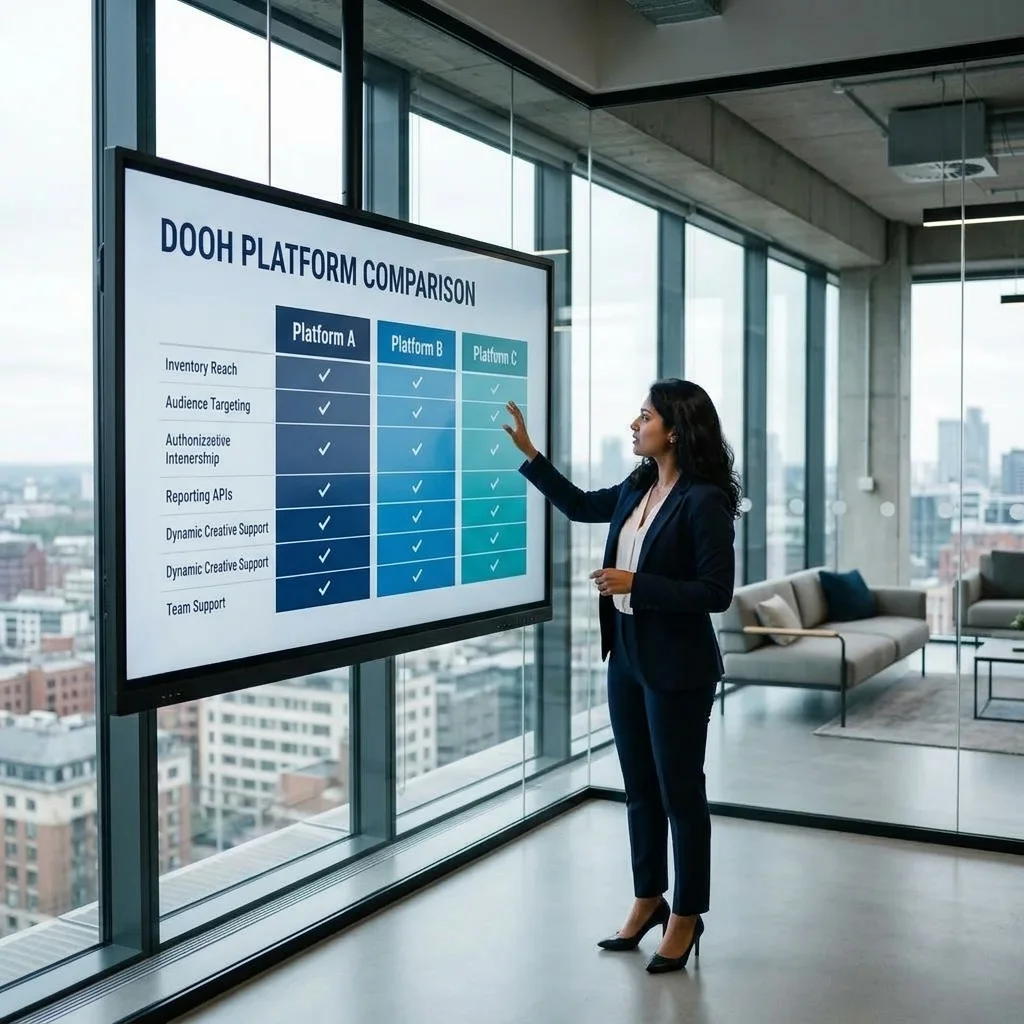



Programmatic DOOH gets sold on the promise of buying billboards and transit screens the same way you'd buy a banner impression. In practice, the mechanics underneath are different enough — no cookies, no device IDs, proof-of-play instead of a served pixel — that a partner who's only ever run standard display or CTV campaigns can get the buy live and still get the measurement wrong. Picking the right pDOOH campaign management partner means evaluating something more specific than "do they do DOOH."
The short answer: a good pDOOH partner should be able to name the specific SSPs and DSPs they route through, explain their proof-of-play methodology in plain language without deflecting to "the platform handles that," show you real dynamic creative capability rather than a static loop, and hand you raw play-level reporting on request. If any of those four things gets a vague answer, treat it as a red flag regardless of how polished the pitch deck is.
1How Programmatic DOOH Buying Actually Works
Programmatic DOOH runs on an extended version of OpenRTB, the same real-time bidding protocol behind standard programmatic display, adapted to account for the fact that a screen isn't a single-user device. Instead of bidding against an individual, you're bidding on a slot in a loop at a specific venue, at a specific time of day, with an estimated audience size derived from foot traffic and dwell-time data rather than a cookie or device ID. The IAB Tech Lab's OpenRTB specification documents how these place-based extensions work, and it's worth asking a prospective partner whether their trading desk actually operates against this spec or against a simplified proprietary wrapper.
Targeting in pDOOH happens at the venue level — categories like transit, gas stations, gyms, airports, or malls — combined with dayparting (a coffee-brand creative in the morning commute slot, a different message for the evening drive home) and increasingly with trigger-based logic like weather or local sports outcomes. None of this works well without a partner who understands venue taxonomy well enough to translate a campaign brief ("reach commuters near our retail locations") into an actual buy strategy rather than a generic "urban screens" package.
It's also worth understanding sequencing and loop position, since these materially affect what an impression is worth: a spot at position one in a six-spot loop performs differently than position six, and a partner who can't discuss loop position and share-of-voice guarantees hasn't done this enough to negotiate on your behalf.
2SSP and DSP Coverage: What to Ask
DOOH supply is fragmented across a handful of specialized SSPs that connect to specific venue networks, and no single SSP has universal coverage of every screen type. A partner worth hiring should be able to tell you, without checking with someone else first, which SSPs they trade through for the venue categories you care about, and which DSPs they execute media buys on — whether that's a dedicated DOOH platform or a broader programmatic DSP like Display & Video 360 that has added DOOH inventory access, documented in Google's Display & Video 360 Help Center.
Ask directly what percentage of a given venue category they can reach programmatically versus what requires a direct-insertion order outside the RTB pipe — a partner who overstates programmatic coverage will quietly fall back to manual buys and either eat the margin difference or pass it to you unexplained. It's a fair question to ask alongside anything you'd ask about broader media buying and programmatic coverage, since the underlying diligence is the same: don't take "we have access to everything" at face value.
Supply path transparency matters here just as much as it does in standard programmatic. If a partner can't tell you whether they're buying direct from an SSP or through an intermediary reseller, you're likely paying an extra margin layer you can't see, and it's worth asking how they'd apply the same ads.txt and sellers.json discipline that's become standard in web and app inventory — the IAB Tech Lab's ads.txt initiative exists specifically to make supply chains auditable, and the more sophisticated DOOH SSPs have adopted equivalent authorized-seller disclosures.
3Proof-of-Play and Verification Capability
Because there's no served pixel confirming an ad rendered on a screen the way there is in web display, DOOH relies on proof-of-play logs generated by the venue's media player — a timestamped record that a given creative asset ran, at a given screen, for a given duration. This is the single most important thing to interrogate in a partner evaluation, because "we get proof-of-play" is not the same as "we can show you the raw logs and explain the reconciliation process."
Ask specifically: does the reporting come from the venue's player logs, the SSP's aggregation layer, or a third-party verification overlay, and how do discrepancies between expected and delivered plays get resolved and credited? A partner who can only point you to a dashboard summary without being able to walk through where the underlying numbers come from is a partner who hasn't actually audited their own supply chain — which means you're trusting a number nobody on the vendor side could reproduce if you asked twice.
Some networks also layer in audience measurement — modeled impressions based on mobile location data or traffic studies — on top of raw proof-of-play. That's a legitimate and increasingly standard practice, but it should be disclosed as a separate, modeled number rather than blended into delivery reporting as if it were a confirmed play count. If your reporting and analytics function needs to reconcile DOOH spend against other channels, insist on that separation up front.
4Creative and Dynamic Content Capability
Static creative on a rotating screen is the entry-level version of DOOH; the actual value of the programmatic layer is dynamic content — creative that changes based on real-time triggers like weather, time of day, local inventory levels, or even live sports scores. A partner should be able to describe a concrete workflow for this, not just claim the capability: how creative variants are built, what data feed drives the swap logic, how many variants can run against a single campaign without blowing up trafficking complexity, and how QA happens across dozens of screen sizes and aspect ratios that differ from venue to venue.
This is also where creative operations discipline matters more in DOOH than in most other channels, because a rendering failure on a public screen is visible, embarrassing, and can't be quietly refreshed the way a broken web banner can. Ask how they QA creative before it goes live on physical screens, not just in a preview environment, and whether they've had — and how they've handled — a rendering failure in production.
5Reporting Transparency and Red Flags
The clearest signal of a weak pDOOH partner is discomfort with specifics. If asked how proof-of-play is generated and they answer with marketing language instead of a technical explanation, if raw play logs aren't available on request, or if venue-level performance gets bundled into a single blended number that prevents you from seeing which locations actually worked, treat those as disqualifying rather than minor friction. The same goes for pricing opacity — a partner who can't break out media cost from platform fees and their own margin is making it hard for you to evaluate whether the buy was efficient.
A good general framework from standard programmatic still applies here: the IAB's guidelines on measurement transparency and viewability disclosure were written for web and video, but the underlying principle — you should be able to see and verify what you're paying for — transfers directly to place-based media, and a mature partner will hold themselves to it without being asked.
If you're currently evaluating vendors and want a second opinion on a proposal before signing, a free ad-stack audit can help you pressure-test their measurement claims against what's actually achievable given their stated SSP and DSP coverage. It's also worth reviewing how a similar evaluation played out in our global DOOH expansion case study, and if you're still deciding between pure DOOH and its programmatic layer, our breakdown of DOOH vs. pDOOH covers that distinction in more depth.