


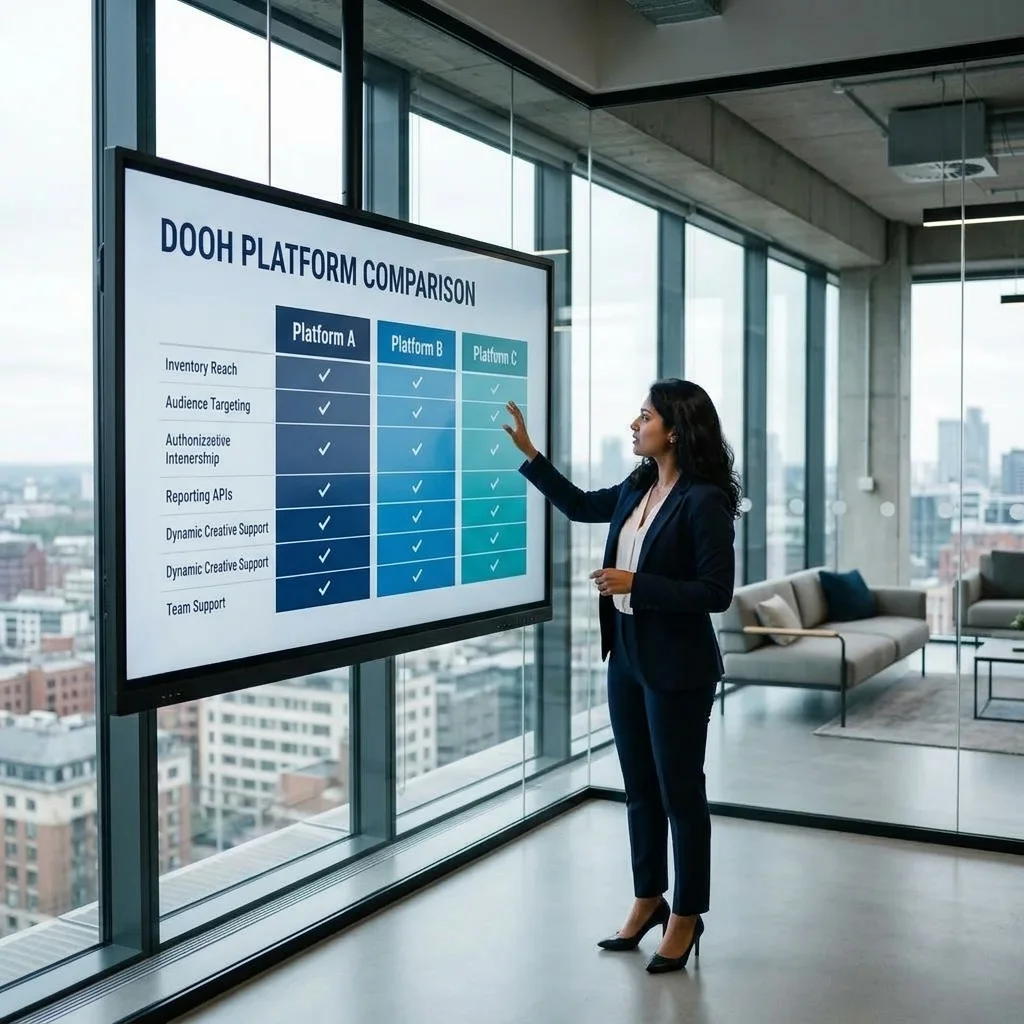
Programmatic digital out-of-home (pDOOH) has quietly become one of the more complicated corners of ad tech to buy and sell in, mostly because the platforms involved don't map cleanly onto the demand-side/supply-side split that display and video buyers are used to. Some vendors sit only on the sell side, some only on the buy side, and a couple straddle both — which makes "which DOOH platform should we use" a different question depending on whether you're the one buying screens or the one selling them.
Short answer: if you're an advertiser or agency buying DOOH inventory programmatically, you're most likely evaluating a demand-side platform like Vistar Media or Hivestack; if you're a venue owner or network operator monetizing screens, you're evaluating a supply-side platform like Place Exchange or the infrastructure Broadsign provides. Vistar operates both an SSP and a DSP, Hivestack is DSP-focused, Place Exchange is an SSP built for OpenRTB-based DOOH transactions, and Broadsign is supply-side infrastructure that became more consequential in programmatic after its 2025 combination with Place Exchange.
1DSP vs. SSP in DOOH: Why the Distinction Matters More Here
In display and video programmatic, most buyers already understand the basic split: a demand-side platform (DSP) lets advertisers bid on inventory across many publishers, while a supply-side platform (SSP) helps publishers make their inventory available to that demand and manage yield. DOOH inherited this same architecture when it moved from static, manually-booked media buys to programmatic, OpenRTB-based transactions — but the physical nature of the inventory (a billboard, a screen in a mall, a digital panel at a gas station) adds wrinkles that don't exist in pure digital.
On the demand side, a DOOH DSP needs to translate audience and location targeting into decisions about which physical screens to buy, often blending mobility and foot-traffic data with more traditional demographic or contextual signals. On the supply side, a DOOH SSP has to manage a much more fragmented inventory landscape — thousands of independent screen networks and venue owners, each with their own hardware, players, and player-level constraints — and make all of that transactable in a standardized way. That's a meaningfully harder supply-side problem than aggregating web or app inventory, which is part of why IAB Tech Lab has spent real effort on OpenRTB extensions specific to DOOH.
If you're building or refining a programmatic buying strategy that includes out-of-home, understanding which platforms sit where in this chain will save you from a lot of misaligned expectations — a DSP salesperson and an SSP salesperson are solving different problems, even when they're both pitching "programmatic DOOH."
2Vistar Media
Vistar Media is unusual in this space because it operates end-to-end — it runs both an SSP and a DSP, rather than picking a single side of the transaction. That gives Vistar a distinct position: venue owners and screen networks can work with Vistar to get their inventory connected to demand, while advertisers and agencies can use Vistar's demand-side tools to plan and buy across that same connected inventory (and other supply Vistar has access to).
Vistar is also known for its investment in spatial and location data intelligence, including a device graph that maps digital behavior (mobile device signals) to physical impressions at specific screen locations. For a buyer, that matters because it's the mechanism that lets you target or measure a DOOH campaign the way you'd target a mobile or CTV campaign — by audience and behavior rather than just by screen location and daypart. Vistar is owned by T-Mobile, which is worth knowing if telecom-derived mobility data or carrier-level scale is part of why you're considering it.
Who tends to evaluate Vistar: advertisers and agencies who want a single point of access to a broad footprint of connected DOOH inventory, and venue owners/networks who want a partner that can plug them into both supply-side monetization and demand-side scale rather than choosing one function.
3Hivestack
Hivestack is a programmatic DOOH demand-side platform with an audience-centric approach to planning and buying — it leans on foot-traffic measurement and custom audience planning to help advertisers define who they're trying to reach and then map that back to screen selection, rather than starting from screen inventory and working backward. Hivestack was acquired by Perion in 2023, which folded DOOH capability into a broader digital advertising portfolio.
For an agency or brand already comfortable buying audience-based campaigns in other channels, Hivestack's framing can feel more familiar than screen-first buying tools — you're specifying an audience and letting the platform find and measure the physical locations that reach it, then reporting back on things like estimated foot traffic influenced by the campaign. As with any foot-traffic or attribution methodology in this category, it's worth asking any DOOH DSP directly how their measurement model works and what it can and can't claim, rather than assuming parity across vendors.
Who tends to evaluate Hivestack: advertisers and agencies whose media planning is already organized around audience segments and who want DOOH folded into that same planning language, alongside their other programmatic channels.
4Place Exchange
Place Exchange is a leading supply-side platform for programmatic out-of-home, and it holds a specific historical distinction: it was the first SSP to make DOOH inventory transactable over standard OpenRTB, which was a meaningful step in moving DOOH away from bespoke, non-standard integrations and toward the kind of open, auction-based buying that display and video demand partners already knew how to plug into.
In late 2025, Place Exchange was acquired by Broadsign, combining a leading OOH SSP with Broadsign's supply-side infrastructure and forming a substantially larger combined inventory pool for programmatic buyers to access through a single connection. For venue owners and screen network operators, that combination is the headline: it changes the calculus of which SSP relationship gives you the broadest, most standardized path to programmatic demand.
Who tends to evaluate Place Exchange: publishers, venue owners, and screen network operators looking for supply-side representation with strong standards alignment and — post-acquisition — a larger pool of aggregated demand connections through the combined Broadsign relationship.
5Broadsign
Broadsign has historically been known as DOOH infrastructure and supply-side technology — the software that screen networks and venue operators use to manage content, scheduling, and operations across their physical inventory. It became significantly more consequential specifically in the programmatic buying conversation following its combination with Place Exchange, which paired Broadsign's supply-side infrastructure footprint with an established, OpenRTB-native SSP.
For a venue owner or network operator already running on Broadsign's infrastructure, the practical benefit of that combination is a shorter path from "screens under management" to "screens transactable programmatically," without needing to separately integrate a third-party SSP layer on top of the infrastructure they already use day to day.
Who tends to evaluate Broadsign: network operators and venue owners who care as much about the underlying screen and content management infrastructure as they do about programmatic monetization, and who want those two things to come from a connected stack.
6How to Choose: A Framework by Buyer Type
Start by identifying which side of the transaction you're actually on, because that alone eliminates half of the vendors above. If you're an advertiser or agency, your candidates are DSPs — Vistar's demand-side tools and Hivestack are the two discussed here, though the broader market includes other demand-side options worth a separate look. If you're a venue owner, screen network, or publisher, your candidates are SSPs and supply-side infrastructure — Place Exchange, Broadsign, and Vistar's supply-side offering.
From there, advertisers should weigh how they want to define and measure audiences (mobility-graph-driven vs. foot-traffic-and-custom-audience-driven), how much of their existing programmatic stack they want DOOH to plug into, and how transparent each platform is about its measurement methodology. Publishers and venue owners should weigh how much of their inventory is already OpenRTB-transactable, how much value they place on infrastructure and content management being unified with monetization, and how the recent Place Exchange–Broadsign combination changes the size of the demand pool available through either relationship. None of these decisions happen in a vacuum — they connect directly to broader questions about programmatic monetization strategy and, for venues just starting to go programmatic, platform implementation sequencing.
7Where This Fits in a Broader DOOH Strategy
Platform selection is only one piece of getting DOOH and pDOOH right — the operational work of trafficking creative to the right screen specs, reconciling delivery across multiple SSPs and DSPs, and reporting results back in a format the rest of your media plan can compare against is where a lot of DOOH campaigns actually lose efficiency. We've covered the broader distinction between traditional and programmatic buying in our DOOH vs. pDOOH breakdown, and our global DOOH expansion case study walks through what that operational layer looks like in practice. If you're not sure which platform fits your setup, talk to our team — we work across multiple DOOH platforms and can tell you honestly which one fits your inventory and goals.